Written By: Sridevi Hariharan
Graphic By: Jessye Fan
College life is a time of hectic schedules, 8 a.m. lectures, sleeplessness, and part-time jobs. It’s a time of learning how to balance homework with social life. During such a tug-of-war, it’s only natural that some students turn to video games, and put their real lives on hold. It makes sense why; all that matters in the moment is leveling up and making sure your player doesn’t lose more hearts, or finishing up that quest; where even if you fail, you’ll easily get respawned without problem.
But what do college students as a whole actually think of this pastime? Are video games a source of pride or distraction? Personally, as someone who does not play video games, I don’t really have a consensus on this, so I thought this would be a subject worth exploring at UT, and decided to conduct a survey amongst 8 students. While the results by no means represent the entire student population, they do offer a glimpse into the gaming habits and opinions of a sample group.

About 5 of respondents were either freshmen or sophomores, while 3 were juniors/seniors. The gender ratio was evenly split; 4 were male, 4 were female. All individuals reported playing video games, with hours played ranging from 0-30 per week. Based on these responses, the average gaming time across all participants was about 12 hours per week. Interestingly enough, one student mentioned that their gaming time had decreased since starting college, likely due to shifting academic and social priorities.
The range of opinions on video games is also very intriguing. Some express a simple liking for video games, while others feel a deep love for them. One person described playing video games as a great way to relax, and another said video games helped them through tough times during their life. Meanwhile, others described having a love-hate relationship with gaming, noting that their enjoyment depended on the quality of a game. On the opposite end of the spectrum, there were also 2 people who viewed video games as a total waste of time and wanted them to be “deleted from existence”. Overall, it seems like opinions were both extensive and ambiguous in this regard.
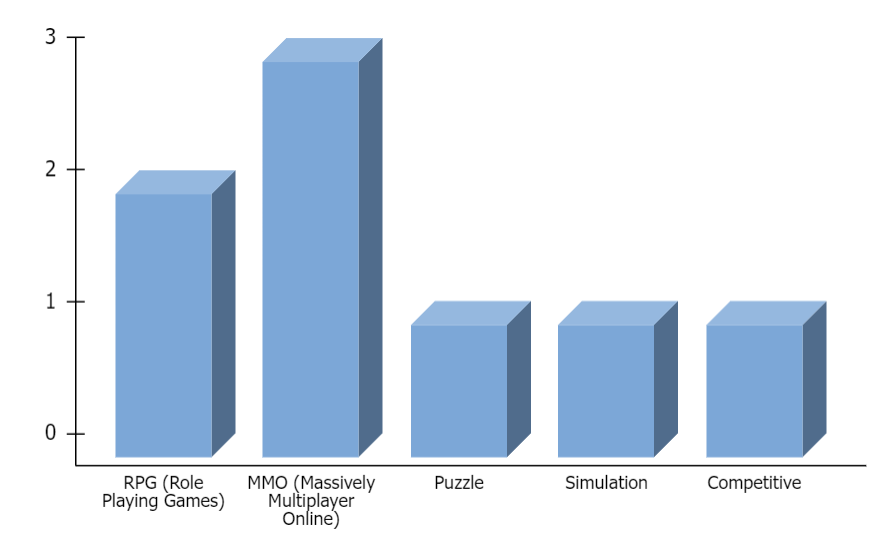
As for game preferences, 3 students said they preferred MMO (Massively Multiplayer) games, while 2 of students enjoyed RPG (role-playing games). Competitive, puzzle, and simulation games were less popular, and least favorite games seemed to include turn-based games that felt slow-based, games that had excessive monetization, and games with poor mechanics. Specifically hated titles included popular games such as League of Legends, Fortnite, Battlefield, and various war games. It appears students thrive on less stressful games that don’t require an excessive time investment, as well as have more social interaction features. It also appears popularity does not necessarily guarantee a positive experience with a game.
While 7 out of 8 respondents said video games had a positive influence on their life, oddly enough, when asked if they had experienced negative effects from gaming, such as stress, or addiction, 6 of them said yes. The survey asked for elaboration on what the positive benefits of playing video games actually were then. Many students agreed when prompted if video games help them with problem solving and teamwork. One respondent had gone as far as to say that video games had fully improved their team work abilities despite disliking group work. However, opinions still did vary, given another person continuously claimed that gaming was ultimately a “waste of time, a tool of procrastination”.
I was curious to hear more about the reasons that some people loved video games and others preferred to avoid them. I gained very valuable insights: some saw gaming as “a good way to relieve stress” or “something to look forward to after work or schoolwork.” Others used it as a way to make connections with people that would have otherwise been impossible, or for emotional management and/or escapism. One student also described video games as a chance to be in a different reality or headspace, and another student discussed how playing video games improved the eye-hand coordination they had struggled with as a child. When prompted about what they would change about video games: answers varied from stopping charging high prices for low-quality games, microtransactions, and too bring back older titles. While these students do enjoy gaming, they share the sentiment that the industry could embrace a more consumer-friendly approach that respects its players. This idea resonates with me as well. In my opinion, video games do not necessarily have to be done away with entirely, but at least played in a way that supports a healthy work-life balance for students.
Like one respondent described it, I too have “nostalgic childhood” memories of playing on a Nintendo DS in the late 2000s, along with Subway Surfers, Wizard101 and Minecraft for a few years. These days, I do not play due to time constraints, fears of unproductivity, and perhaps changing interests. Still, I recall how gaming recreated an experience similar to reading a book, allowing me to experience different worlds that expanded my creativity and knowledge. For others, gaming opened up unexpected doors: my older brother, for instance, developed a great interest in history through Sid Meier’s Civilization, even considering a career as a history professor due to it. To him, video games were not only for entertainment, but a path to academic interests and careers that he might have not otherwise discovered.
Evidently, video games have benefitted many people in different ways, such as allowing for teamwork building and networking, improving cognitive and coordination abilities, mental relaxation, and many more. However, they may also come with potential downsides, such as impacting grades, sleep, and in some cases, leading to isolation or addiction. With such power to influence student life and mental health, striking out a balance between gaming and our academic priorities is paramount if we wish to gain the greatest level of fulfillment from them.
 The Liberator Magazine
Leave a comment