Written By: Ella Oberle
Graphic By: Naomi Ichiriu


In May 1989, a recent college graduate moved to Los Angeles, California, to pursue a career in journalism. He had a particular interest in entertainment, and almost a decade after his move, Warner Bros. purchased his script for a rom-com entitled Why Can’t I Be Audrey Hepburn? While the film was never made, it was his first taste of success in the industry, and certainly not his last. Today, producer, writer, and director Ryan Murphy has six Emmys and has created and co-created over fifteen shows.

	His catalog oscillates between comedy, horror, and drama, with notable installments including Glee, 9-1-1, American Horror Story, and Feud. In an interview with Time, he noted how, despite early successes, he felt ostracized in the industry due to his sexuality and had to fight for projects to be taken seriously. This struggle carried into his work, as he explains: “Everything I’m working on is about one idea—taking marginalized characters and putting them in the leading story.”

	While his execution of this has been received with mixed reviews, this intention is seen in his work, for example: Glee, which included various LGBTQ+ characters and was semi-inspired by Murphy’s own experience in choir, Pose, which explores the struggles of the transgender and African American communities in the 80s, or even All’s Fair, which follows an all-female law firm.

	However, in addition to spotlighting marginalized communities, Murphy was incredibly interested in exploring the horror genre. Thus, he created American Horror Story, which was an instant success, alongside projects Scream Queens, The Watcher, and, more recently, Monsters.

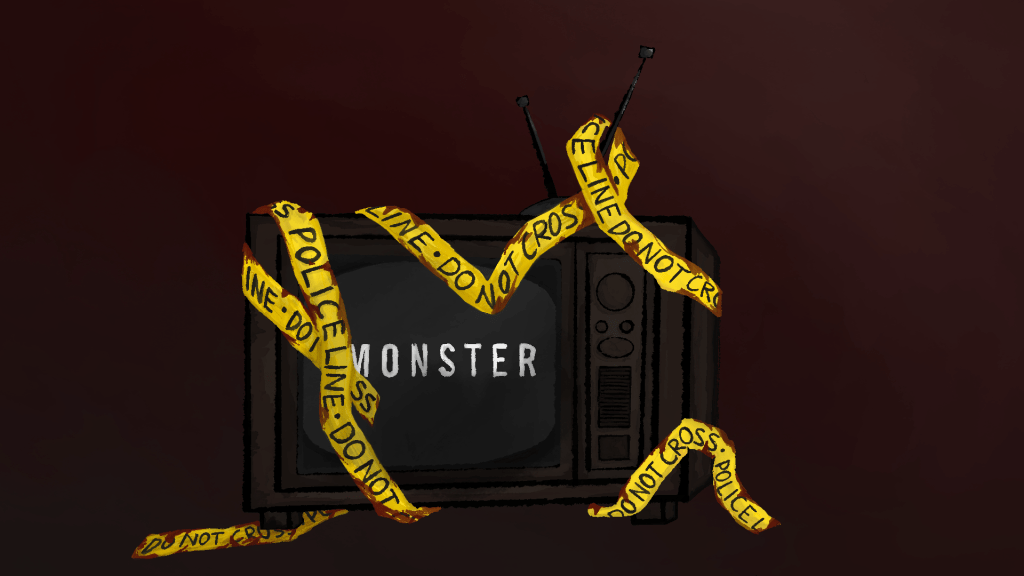
Monsters deviates from the majority of his work, as it is not inspired by communities or specific time periods, but rather directly based on real-life events and people. Now in production for its fourth season, it has covered the crimes of Jeffrey Dahmer, the Menendez Brothers, and Ed Gein; the show’s apparent thesis is ‘Are monsters made, or are they born?’ In an interview with Netflix’s Tudom, Murphy explained that the show seeks to offer a unique opinion on these crimes and: “The show has an approach where it talks about countless perspectives, and a perspective is not a lie. A perspective is an opinion, and the show has an obligation to all of those opinions.”

	Murphy’s emphasis on perspective is intriguing, considering how the show has garnered intense backlash for arguably glamorizing serial killers. Regardless of the critique, Murphy stands beside his work: “Call me camp. Call me crazy. Call me wild. Call me extreme. Call me erratic. The one thing you can’t say is that I don’t try. Actually, I don’t care what you call me. As long as you call me.” However, in my opinion, Monsters is an example of the worst parts of true crime as it exudes a troubling lack of respect and, funnily enough, perspective.

True crime has continuously captivated audiences for centuries, with its origins dating back to the 1500s when pamphlets were printed to inform citizens of crimes committed in their vicinity. While this was initially utilized for safety, it eventually garnered an audience who was morbidly intrigued by the reports. As time progressed, the interest eventually gave rise to the mystery genre, heavily popularized by crime-solving detectives such as Sir Arthur Conan Doyle’s Sherlock Holmes and Agatha Christie’s Hercule Poirot in the early 1900s. However, the formation of the true crime genre – defined by its consumption of media that relays strictly real-life crimes – is largely attributed to Truman Capote’s book, “In Cold Blood.” The novel examined the murders of the Clutter family in the late 50s, both from the perspective of the family and the culprits. Its critical and commercial success established that there was indeed an audience interested in true crime; thus, true crime has evolved to what we know it today, a dark, sprawling genre of books, films, and podcasts dedicated to relaying criminal activity, largely murders. While its ethics have long been debated, Monsters is a true low for true crime media as a whole.

When the first season of the show covering Jeffrey Dahmer was pitched to actor Evan Peters, he was initially uninterested. However, he remarked in an interview with Deadline that: “I read [the script] and the writing was brilliant and very careful to show many different perspectives, not just Dahmer’s — trying to illuminate how the system tragically failed the victims’ family members, neighbors who tried to sound the alarm, because of prejudice… I felt changed by it, and I sincerely hoped that some good would come out of [the show] if people watched it.” His interpretation of the show, though perhaps not aligned with audience perception, alludes to the best of true crime. True crime will always be polarizing, and it should prompt consumers to fight to improve the justice system and advocate for victims and their families.

However, putting aside the factual inaccuracies of Dahmer, the online reaction to the show was mixed. Much of the online discourse–perhaps to be expected–surrounded Dahmer himself. Yet, it was not how disgusting a human being he was, but instead, users expressing compassion towards the serial killer. It is one thing to admire Peters’ performance of Dahmer or Peter himself. It is another thing to post videos of how physically attractive Dahmer was or how he is misunderstood and a victim. In my opinion, he–alongside all serial killers–should never be romanticized or praised. While one might think this is obvious, the reaction to Dahmer suggests otherwise. While sure, you can have sympathy towards him for having a rough childhood, that does not excuse the horrific crimes he committed and the lives he stole.

But how does this connect to Murphy? While he is not necessarily accountable for audience perception, he is to blame for exploiting the crimes, the victims, and the victims’ families. While most of the murders in Dahmer are committed off-screen, the show graphically depicts the before and after of the killing of real people. The recreation of real-life murders, real people with hopes, dreams, and loved ones, is designed, filmed, edited, and released for millions of people to see.

Rita Isbell, whose brother Errol Lindsay was murdered by Dahmer, spoke to Business Insider about seeing herself in the show: “When I saw some of the show, it bothered me, especially when I saw myself—when I saw my name come across the screen and this lady saying verbatim exactly what I said. If I didn't know any better, I would've thought it was me. Her hair was like mine, and she had on the same clothes. That's why it felt like reliving it all over again. It brought back all the emotions I was feeling back then. I was never contacted about the show. I feel like Netflix should've asked if we minded or how we felt about making it. They didn't ask me anything. They just did it. But I'm not money hungry, and that's what this show is about, Netflix trying to get paid.”

While Murphy claims that he reached out to twenty members of the victims’ families while making the show, and none responded, it brings forth the question of why he continued with the show if he truly cared about respecting the victims’ families. Wouldn’t he have halted production and tried harder to hear what they had to say, or to get their permission? While one can argue that it's necessary to depict these crimes for education and to ensure victims are not forgotten, that should be done with the perceptions of victims and their families in mind. Instead, they are retraumatized while streaming platforms like Netflix and directors such as Murphy profit off it. Steven Hicks, Steven Tuomi, Jamie Doxtator, Richard Guerrero, Anthony Sears, Raymond Smith, Edward W. Smith, Ernest Miller, David C. Thomas, Curtis Straughter, Errol Lindsey, Anthony Hughes, Konerak Sinthasomphone, Matt Turner, Jeremiah Weinberger, Oliver Lacy, and Joseph Bradehoft were real people who had family, hopes, and dreams. Yet they are reduced to a plot device in a show that determines if their killer’s monstrous nature was inherent or constructed.

Yet, the commercial success of Dahmer prompted a second season of Monsters, which Murphy selected to cover Erik and Lyle Menendez. The two brothers were convicted of murdering their parents in the 90s, with the courts deeming their motives financial, whereas the brothers, as a result of years of psychological and sexual abuse. In Murphy’s words: “It’s informed an entire generation about that case and launched millions of conversations about sexual abuse. The show doesn’t shy away from any of these topics… More than that, I think that male sexual abuse is something that’s really not been talked about a lot in our culture, certainly not then when these trials happened, and certainly not even now, but I think people are talking about that, and I find that to be gratifying and good.”

It is indeed excellent that highlighting the brothers’ case has sparked conversations on sexual abuse and movements for courts to reevaluate the brothers’ convictions. Murphy states that the show is “the best thing to happen to the brothers in thirty years,” which is, again, an interesting perspective considering that the brothers and their family say otherwise.

Shortly after the show’s release, the Menendez family posted a response that stated the show was a “...phobic, gross, anachronistic, serial episodic nightmare… riddled with untruths.” Erik also spoke out about the show and how “...Murphy shapes his horrible narrative through vile and appalling character portrayals of Lyle and of me and disheartening slander.”

The most blatant inaccuracy in the show lies in Murphy’s depiction of the brothers’ relationship, in which he hints at incest. While this is already beyond sick, it is even more so considering Murphy’s perspective that: “I have no interest in talking to [the brothers]. I don’t know what I would say to them. What would I ask them? I know what their perspective is.” Yet, does he? How can you understand someone if you’ve never even spoken to them? How can you make a show about someone’s crimes that stem from horrific trauma if you lack the guts to look at them face-to-face? Wouldn’t it be vile if a show depicted incest because the show offers a perspective that ‘theoretically could’ve happened?’ Murphy claims the Menendez brothers should “send him flowers” for spotlighting their case, and his response to the show’s backlash showcases a deplorable ego.

	But, despite these concerns, the show was a commercial success again, and Murphy soon began working on the third season dedicated to Ed Gein, the “Butcher of Plainfield.” In the 1950s, Gein confessed to the murders of two women, Bernice Worden and Mary Hogan, and according to Britannica, an examination of his home revealed he “systematically robbed graves and collected the body parts of women, which he used to make household items and clothing.” His brutal crimes inspired films such as Psycho, The Texas Chain Saw Massacre, and The Silence of the Lambs, a fact that Murphy spotlights throughout the season. In an interview with Charlie Hunnam, who plays Gein, Murphy explained that the reason he chose Ed Gein for the next season of Monsters was: “People know a lot about Jeffrey Dahmer or the Menendez brothers, but I wanted to do something cultural... Ed changed the way we look at entertainment in some weird way, because suddenly, highlighting human suffering became entertainment that people would pay for.”

	In the same interview, Hunnam explains how, after filming ended, he visited Gein’s grave: “But I also needed to say goodbye to Ed. So I drove to Plainfield and spent five or six hours at his grave and walking around the town. I wanted to express one thing specifically to him, that I hope that we had for the first time told his story in an honest and unbiased way.”

	…what? This emphasis on honesty starkly contrasts with Murphy’s previous statement that the show presents opinions and perspectives. The incest was included because it could’ve happened, and the arguably glorified depiction of Dahmer is just an opinion of how he was, not a fact. Also, why the hell are they worried about assuring Gein that they told “his story” correctly? What about the women he killed and dismembered and the graves he robbed? Are you not concerned with how they are depicted, but instead if they respected a serial killer?

	Evidently not, as the show depicted Gein and Worden’s relationship as sexual, which is not based on any fact whatsoever. Further, the show includes Evelyn Hartley, a fourteen-year-old girl who went missing in Wisconsin in 1953. While Hartley’s disappearance has never been solved, the show depicts Gein kidnapping and murdering her, who, oddly, is played by twenty-five-year-old Addison Rae. Why would Murphy cast a twenty-five-year-old woman as a fourteen-year-old child? Why would he include this in the show if it has never been confirmed and is just disrespectful and unnecessary to Hartley (who, again, was a child)?

	The show also makes continuous nods to the films Gein allegedly inspired, with plotlines connected to the filmmakers and actors behind Psycho, The Texas Chain Saw Massacre, and The Silence of the Lambs. The show attempts to convey that it is because of audiences who “can’t look away” that the horror genre has flourished and depictions of true crime have prospered. While this is true enough, the show’s execution of it is clunky, and it just distracts from the truth. Gein should not be viewed as an incredible pop-culture inspiration, but instead just as a murderer.

	Though there is much, much more to say about Murphy and each of his shows, one must be cognizant of how inherently flawed this media is. Why are we so focused on humanizing and exploring the motives of serial killers? What is the significance of whether they were born a monster or became one? Dahmer and Gein should not be glamorized, and the Menendez brothers should not have been misconstrued into people they’re not. While Murphy may say Monsters is an excellent piece of media that continues to challenge and intrigue viewers, it is, as the Menendez family said, “Perhaps, after all, Monsters is all about Ryan Murphy.”
A Deadly Perspective
by
Tags:
 The Liberator Magazine
Leave a comment