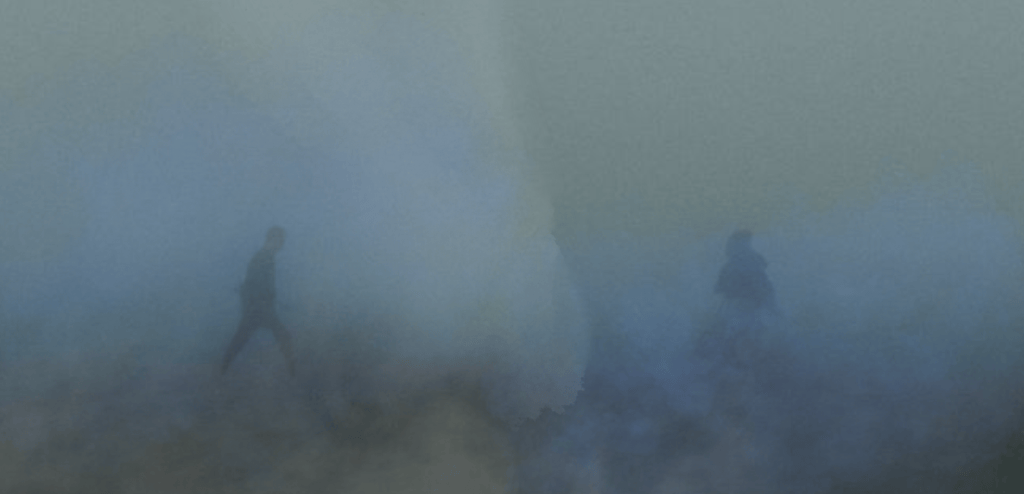
by: David Telles
November, 2023, 9 p.m. (GMT) — London, UK
It drove us insane.
The plane ride has the atmosphere of an outdoor rock concert in July. The cabin was muggy, the floor trembled beneath our feet, and the passengers seemed determined to occupy every inch of space except their assigned seats. Genesis looked at me with the weary expression of someone who had been listening to my complaints for the better part of three years.
“I know,” she said.
“I didn’t say anything.”
“You were about to.”
I turned toward the window. Somewhere below us, the Atlantic stretched into a darkness so complete that it seemed less like an ocean than an absence of anything else. My reflection stared back at me in the glass with tired eyes, an uneven mouth, the faint scar that interrupted my left eyebrow. I had acquired it years ago, before Genesis, and she had once told me that it made me look as though I had survived a particularly uninteresting duel.
“We could have flown Delta,” she continued.
“And missed the opportunity to be slowly cooked alive in this tin can? Unthinkable.”
“We would have had less money for the trip.”
“Your idea of recreation has always been suspiciously inexpensive.”
She smiled. “But you like it.”
She reached for my hand. I let her take it, and she rubbed her thumb over my knuckles in the absentminded way she did when she was reading or thinking. I had learned that she could do both without paying attention to anything else in the world. Sometimes I suspected that if the earth opened beneath her feet, she would finish her sentence before looking down.
I squeezed her hand.
“Just so we’re clear,” I said, “if I die of a blood clot somewhere over the Atlantic, I
expect you to cite me properly in your dissertation.”
“Of course.”
“Full academic honors.”
I laughed despite myself. She looked pleased, as though she had accomplished
something.
At the time, I could still recognize the particular shape of her smile. I think her eyes were dark like coffee, though I have occasionally remembered them as blue. It is an insignificant distinction, perhaps, but I have learned to distrust insignificant distinctions. They are often the first things to disappear.
We had been together for three years, long enough to have developed a private language of gestures and unfinished sentences, of arguments that ended in laughter and silences that required no explanation. Genesis knew the sound I made when I was trying not to laugh. I knew when she was frightened because she became unusually precise with her words. We had mistaken this familiarity for a kind of permanence. We believed that whatever happened to us, we would at least be able to tell the story afterward.
The purpose of our trip was, ostensibly, academic. Genesis was a doctoral candidate in folklore studies, researching the stories, beliefs, and oral traditions associated with the Yorkshire moors. For months, our apartment had been slowly consumed by photocopied manuscripts, books about regional legends, and handwritten notes that migrated from the dining table to the sofa and occasionally into the bed. I had learned to sleep beside a book about eighteenth-century apparitions without asking questions.
She intended to interview local residents, examine historical accounts, and visit the places associated with reports of disappearances and unexplained sightings. I had been recruited to assist with documentation. My contribution consisted of carrying equipment, taking photographs, and occasionally asking questions that Genesis considered unhelpful but necessary.
I had agreed to come because I loved her. I had also agreed because she had a talent for making even the most unreasonable undertaking sound like an opportunity neither of us could afford to miss. The journey north from London was long and gray. Genesis spent most of it reading, occasionally turning toward me to share a passage she found interesting. I listened when I could be bothered, watching the countryside widen beyond the train window. The houses grew sparse. Stone walls divided the fields into irregular shapes. The sky seemed to descend as we traveled, pressing the land flatter beneath it.
By the time we reached Yorkshire, rain had begun to gather on the windows. Our guesthouse stood in a small village at the edge of the moors, a stone building with narrow windows and a garden that appeared to have surrendered to the weather. Mrs. Whitaker, the proprietor, greeted us at the door and showed us upstairs to a room with two narrow windows overlooking the hills.
She explained the arrangements for breakfast and pointed out the nearest telephone. Before leaving, she advised us against wandering too far onto the moors after dark.
Genesis, naturally, asked why.
Mrs. Whitaker paused with her hand on the doorknob.
“T’ weather turns reight quick out there,” she said. “Easy to loise yer bearings.”
“Is that a common problem?” Genesis asked.
“Depends on who ya ask.”
Mrs. Whitaker left before Genesis could pursue the matter.
I closed the door.
“Don’t.”
“I haven’t said anything.”
“You have a look.”
“What look?”
“The look you get when someone has accidentally handed you an entire dissertation.”
She laughed and dropped her bag onto the bed. I crossed the room and drew her toward me, wrapping my arms around her waist. She leaned against my chest, still smiling, and I rested my chin on the top of her head.
Beyond the garden, the land rose into a series of dark, rolling hills. Fog gathered along the ridges, erasing their outlines until the hills seemed to dissolve into the sky.
For a moment, I thought I saw someone moving along the highest ridge.
I blinked.
The ridge was empty.
“Beautiful, isn’t it?” Genesis murmured.
I looked down at her. “What is?”
“The view.”
I turned back toward the window.
“Yes,” I said. “Beautiful.”
That night, rain tapped against the glass. Genesis fell asleep almost immediately, one hand resting beneath her cheek. I lay awake beside her, listening to the wind move around the building. Every so often, I heard what sounded like footsteps in the gravel outside. They approached the window, stopped, and began again after a pause.
I did not get up to look.
November, 2023, 8 a.m. (GMT) – Outskirts of Yorkshire, UK
The following morning, the fog had swallowed the road behind us by the time we reached the moors.
It was not especially thick at first. It lay in the hollows and gathered around the low stone walls, leaving the higher ground visible in patches. The rain had dwindled to a fine mist that darkened our coats and collected in Genesis’s hair. She walked a few paces ahead of me, turning occasionally to make sure I was still there.
I remember thinking that she looked strangely unfamiliar against the landscape. There was nothing unusual about her appearance; she wore the same dark coat she had packed for the trip, the same glasses she pushed up the bridge of her nose whenever she was concentrating. Yet from a distance, she seemed less like a person I knew than someone I had encountered in a dream and mistaken for a memory. I blamed the weather.
We had come to document the stories that lingered in the region: apparitions, disappearances, lights moving across the hills at night. Most of them were probably ordinary incidents transformed by repetition and distance. That was what we had told ourselves, anyway. We had cameras, notebooks, a portable recorder, and enough skepticism between us to make the whole undertaking resemble academia.
Then I saw someone standing among the heather.
I stopped so abruptly that Genesis turned back.
“What’s wrong?”
“Someone’s there.”
She followed my gaze, squinting into the fog.
“Where? Damn, I think it’s my glasses again.”
I pointed toward a rise in the field. Perhaps a hundred yards away, a figure stood perfectly still, its arms hanging at its sides. It wore a dark coat. The head was indistinct, possibly covered by a hat. The body faced across the field, perpendicular to us.
“Oh,” Genesis said, wiping her glasses off with her sweater. “That’s a tree.”
“No, it isn’t.”
She laughed softly. “You always do this.”
“Do what?”
“Turn things into people.”
I looked at her. “It’s a person.”
“It’s a tree,” she exclaimed.
I raised the camera. She caught my wrist before I could take the picture.
“Leave it.”
“Why?”
“Because it’s a tree, dude.”
I pulled my wrist away, more sharply than I intended, and pressed the shutter.
The figure did not move.
For several seconds, I continued watching it through the viewfinder. Then a gust of wind pushed the fog across the field, and the figure disappeared behind it. When the mist thinned again, there was nothing standing among the heather. Genesis gave me a look of such exaggerated patience that I almost apologized.
“Happy?” she asked.
“Thrilled.”
She rolled her eyes and we continued walking.
For the rest of the morning, nothing unusual happened. Genesis photographed the stone walls and recorded the locations of several old paths. I took pictures of the landscape, occasionally stopping to adjust the focus. The fog lifted and returned, changing the distance between objects without seeming to move them. By the time we headed back to the village, I had almost convinced myself that I had mistaken a tree for a person. That evening, we developed the film.
The darkroom was an improvised arrangement in the small bathroom, where we had hung a towel over the window and set up the equipment Genesis had insisted on bringing. We had chosen the film deliberately. Genesis wanted the photographs to be physical records, something she could annotate, compare, and preserve alongside her field notes. She distrusted the ease with which digital images could be altered, although she had never offered a particularly convincing explanation for why chemical processes were inherently more honest.
We worked mostly in silence, waiting for the images to emerge. The first few photographs showed the path, the stone wall, and the distant hills. The fog had softened everything into shades of gray. The fourth showed a cluster of rocks. The fifth showed the same landscape from a slightly different angle. The seventh photograph was the one I had taken of the figure. I lifted it from the developing tray. There was no tree.
There was a man standing in the field.
He wore a dark coat and stood with his arms at his sides, his body turned across the landscape. The fog had blurred his features, but the outline of his head and shoulders was unmistakable. Genesis leaned over my shoulder and neither of us spoke.
I placed the photograph beneath the lamp. The image was ordinary enough in every respect except that it contradicted what Genesis had seen. Or what she claimed to have seen. The figure stood exactly where I remembered it, in the same posture, at the same distance from the stone wall, but his head was turned.
In the field, he had faced away from us. In the photograph, his face was angled toward the camera. Not directly. Not quite. But enough that I felt, with a certainty I could not explain, that he had been looking at me.
“That isn’t possible,” Genesis said.
“I’m glad we’ve established that.”
She ignored me and lifted the photograph closer to the light.
“The perspective is wrong.”
“Is it?”
“If you were standing where you said you were standing, then the figure shouldn’t be looking in that direction.”
“Perhaps he turned.”
“When?”
“Between the time I saw him and the time I took the photograph.”
She looked at me.
“You said he didn’t move.”
“I said he didn’t move when I was looking at him.”
“That is not the same thing.”
“No,” I said. “Apparently not.”
We examined the negatives twice. There was no obvious damage, no double exposure, no indication that the film had been altered. The other photographs contained nothing unusual, although Genesis insisted that we inspect them for discrepancies in the landscape.
At one point, she held up a photograph of the stone wall and asked whether I noticed anything strange about it. I told her that it was a stone wall. She studied me for a moment before setting it down.
“Right,” she said. “Of course.”
I watched her thumb move along the edge of the photograph. She had a faint scar across one knuckle, a thin white line I had once traced with my finger while she lay beside me in bed. I remember that scar more clearly than I remember the exact color of her eyes. I have tried to decide whether this is because the scar was distinctive or because I have spent so much time afterward trying to preserve the details that mattered.
“Can we go back tomorrow?” she asked.
I looked at her. “To the moors?”
“If the figure was actually there, we should be able to establish its position relative to the path. We can photograph the same location from different angles, compare the landscape, and see whether the conditions explain the discrepancy.”
“And if they don’t?”
She hesitated, then placed the photograph on the table.
“Then we won’t have an explanation yet.”
I wanted to argue. I wanted to tell her that we had traveled halfway across England to investigate stories that had survived precisely because no one had been able to explain them. But I had been the one to raise the camera. I had been the one who insisted that a man stood among the heather. I had taken the photograph.
“Fine,” I said. “But if we find a second impossible man, I’m going back to London.”
She smiled, though the expression did not quite reach her eyes.
“Deal.”
She reached across the table and took my hand. I let her. Later, after she had gone to bed, I remained at the table with the photograph beneath the lamp. I was almost certain the man’s face had changed.
I did not tell her.
December, 2023, 8 a.m. (GMT) — Yorkshire, UK
The next morning, Genesis was already downstairs when I arrived for breakfast. Her notebook lay open beside her plate, and the photograph rested beneath her hand.
“You’ve been looking at it again,” I said.
“Good morning to you, too,” she said with food in her mouth.
I sat opposite her and poured myself some tea.
“I thought we agreed to leave it alone until we’d had a chance to think.”
“We agreed to go back to the location.”
“Did we?”
She looked up.
For a moment, I could not remember the conversation clearly. I remembered the photograph, the rain against the windows, and Genesis taking my hand. I remembered telling her I wanted to go back to London. Whether I had agreed to return to the moors, I could not say.
“You said you wanted to know where the photograph was taken,” she said.
“I wanted to know how it happened.”
“Isn’t that the same thing?”
“No, Genesis. It really isn’t.”
She lowered her eyes to the photograph, her expression going cold.
“I was going through my notes last night,” she said. “There are accounts of people seeing
figures on the moors that other witnesses couldn’t see. Sometimes the figure appears in a
photograph or painting afterward.”
I set down my cup. “And you thought this was a good time to mention that?”
“I didn’t think it was relevant before.”
“Before yesterday?”
She pressed her lips together.
“I know how it sounds.”
“Do you?”
She looked at me then, and for a moment I saw something beneath her usual composure. Not fear exactly, but the effort of keeping fear from becoming something more substantial.
“I don’t know what I think,” she said.
It was the first honest answer she had given me since we arrived. I reached across the table. She took my hand, and we sat that way for a while, neither of us looking at the photograph.
Then she said, “We should speak to Mrs. Whitaker.”
I almost laughed. “Of course. Why didn’t we think of that before?”
“Don’t.”
I stopped.
The word had come out more sharply than either of us expected. Genesis withdrew her hand and returned to her notebook. We finished breakfast without speaking. Mrs. Whitaker was in the sitting room, polishing a small collection of teacups. She listened to Genesis’s questions with an expression of mild irritation, occasionally interrupting to correct a date or ask what precisely we hoped to learn.
“People see all sorts out there,” she said at last. “Fog makes a fool of the eye.”
“Have you heard of people seeing someone who isn’t there?” Genesis asked.
Mrs. Whitaker continued polishing the cup.
“People see what they expect to see.”
“And if they both see the same thing?”
The woman looked up.
“Then I suppose they have something in common, don’t they?”
Genesis waited, pen poised above the page.
Mrs. Whitaker set the cup down.
“Doesn’t mean they saw the same thing.”
I shifted in my chair.
“What do you mean?”
She looked at me for a long moment. Her eyes were pale and watery, her expression neither threatening nor particularly interested in us.
“You can walk the same road as someone for years,” she said, “and still not know what they’re looking at.”
Genesis jotted something down.
I watched her do it, and for the first time I resented the notebook. Everything we encountered became material to her. A warning became a quotation; a frightening event became an entry in the field notes. I could not tell whether she was trying to understand what was happening or simply trying to make sure it belonged to her.
“Have you ever heard of a figure appearing in a photograph after the fact?” I asked.
Mrs. Whitaker’s hand stopped moving.
For a moment, the room seemed to grow quieter.
“Why would you go and ask me that?”
“We took a photograph yesterday,” I said. “There was someone in it we hadn’t noticed
properly when we took the picture.”
“And what did you see?”
“A man.”
“Did you both see him?”
“No,” Genesis said.
I turned toward her.
She met my gaze. “I didn’t see him in the field. They did.”
Mrs. Whitaker folded the cloth and placed it beside the cups.
“Best leave it be, then.”
“Why?” Genesis asked.
The woman shook her head.
“Because you’ll spend all your time trying to decide what you saw, and none of it wondering why you were looking in t’ first place.”
She disappeared into the kitchen before Genesis could ask another question.
For several seconds, neither of us moved. Then Genesis resumed writing.
“What did she mean by that?” I asked.
“I don’t know.”
“You don’t know, or you don’t want to tell me?”
She stopped.
“What is that supposed to mean?”
“Nothing.”
“No, go on.”
I looked toward the kitchen doorway. Somewhere behind it, a cupboard shut with a dull
thud.
“I just wish you’d stop treating this like a research opportunity.”
Genesis closed her notebook.
“What else am I supposed to treat it as?”
I wanted to tell her I was frightened. The word sat behind my teeth, humiliating and stubborn. I could already imagine the questions she would ask, the notes she would take, the way she would study my face while I tried to explain something I scarcely understood myself. So I said nothing. She reached across the table for my hand. I pulled it away.
Her expression changed. She looked down at her notebook, and I realized that I had hurt her. I wanted to apologize, but I could not bear the thought of returning to the conversation. I could not bear the thought of her touching me and feeling, for even a moment, that she understood what I was afraid of.
We did not speak for the remainder of the morning.
December, 2023, 12 p.m. (GMT) – Outskirts of Yorkshire, UK
We returned to the moors shortly after noon.
The rain had stopped, but the ground remained saturated, and the clouds hung so low that the hills appeared to have been cut from the same gray material as the sky. Genesis carried the camera while I followed with the notebooks and recording equipment. We retraced our steps, marking the path as we went and photographing the landscape from several angles. We found the stone wall without difficulty.
Beyond it, the land sloped into a shallow valley where patches of heather gave way to exposed rock and dark, waterlogged earth. Genesis compared the landscape with our photographs, occasionally checking the compass on her phone. I stood a few feet away, looking toward the place where I had first seen the figure.
There was nothing there.
“Does it look familiar?” she asked.
“Yes.”
“Are you certain?”
I gave her a weary smile. “Would you prefer that I make something up?”
She sighed and returned to the photographs.
We spent an hour examining the area. Genesis found a tree near the edge of the valley, its branches twisted by the wind and its trunk leaning at an angle that might, from a distance, have resembled the shoulders of a person. She photographed it from several positions and asked me to compare the images with the original.
“It isn’t the same tree,” I said.
“How can you know that?”
“I just know.”
She looked at me for a moment, then turned away. Eventually, she suggested that we photograph the field from the exact location where I had stood the previous day. She took three pictures, adjusting the angle each time, and handed me the camera. The first showed the valley. The second captured part of the stone wall. The third was almost entirely obscured by fog.
“Anything?” she asked.
“No.”
She took the camera back.
“That’s something, at least.”
“Is it?”
She didn’t answer.
We were about to leave when I noticed a patch of disturbed earth near the wall. The heather had been pressed flat, revealing several narrow impressions in the mud.
Footprints. They led away from the path and down toward the valley, where they disappeared beneath a thickening layer of fog.
“Genesis.”
She came over and crouched beside me. We examined the impressions in silence. They were too distinct to be old, although the rain had blurred their edges. The footprints led in a straight line across the slope and stopped in the middle of the field.
“Could be anyone,” Genesis said.
“Of course.”
“Or they could be older than they look. The rain might have altered them.”
“Naturally.”
She looked at me, irritation beginning to show.
“Would you stop doing that?”
“Doing what?”
“Agreeing with everything I say as though you’re making fun of me.”
I stood.
“I’m not waiting for you to embarrass yourself, Genesis. I’m waiting for you to tell me
what you actually think.”
She opened her mouth, then looked down at the footprints.
“I think we should go back.”
It was the first time she had suggested abandoning an investigation.
I offered her my hand. She took it, though her attention remained fixed on the fog
gathering at the bottom of the valley.
As we turned toward the path, I looked back once more.
Someone was standing beside the stone wall.
I stopped.
The figure was perhaps twenty yards away, half-concealed by the mist. It wore a dark coat and stood with its arms hanging loosely at its sides, facing us. I recognized the posture before I recognized anything else: the slight inclination of the head, the way its weight rested more heavily on one leg than the other.
“Genesis,” I whispered.
She followed my gaze.
For several seconds, neither of us moved.
Then she tightened her grip on my hand.
“Do you see him?” she asked.
“Yes.”
“Tell me what he looks like.”
I described the coat, the posture, and the angle of the head. She repeated each detail under her breath, as though she were checking my answers against a list. When I had finished, she nodded slowly.
“I see him, too,” she said.
The relief I felt was so sudden that it almost brought me to tears. Whatever else had happened, whatever else might happen, I was not alone in this. The figure began to turn. Its face emerged from the fog.
It was mine.
Not a resemblance, not a vague suggestion of familiar features. It was the face I saw each morning in the mirror, down to the uneven line of the mouth and the faint scar beside the left eyebrow. The expression was difficult to read, though there was something almost apologetic about it, as if the figure had arrived late to an appointment it had never intended to keep.
Beside me, Genesis drew a sharp breath.
The figure looked at me.
Then it smiled.
I could not move. I could not remember how one moved, how a body was supposed to respond when confronted with something that should not exist. Genesis’s hand trembled in mine. The fog shifted across the field. When it cleared, the figure was gone.
For a long time, neither of us spoke.
I turned to Genesis, searching her face for some indication that she had seen what I had seen. She was staring at me with an expression I had never encountered before, something between terror and recognition.
“That wasn’t you,” she whispered.
I tried to speak, but my throat had tightened. She shook her head.
“I thought it was you.”
I wanted to ask what she meant. I wanted to demand that she explain why she had said it as though the distinction mattered, as though there were some difference between the person standing beside her and the person we had just watched disappear into the fog. Instead, I looked down at our hands. For a moment, I thought I could see a third hand resting over them.
Then Genesis let go.
December, 2023, 4:45(?) p.m. (GMT) – Yorkshire, UK
We returned to the guesthouse before the light began to fade.
Genesis went upstairs without speaking. I remained in the sitting room, where Mrs. Whitaker had left a small fire burning in the grate. I listened to the occasional crackle of the wood and tried to arrange what had happened into a sequence that made sense.
We had seen a man. We had seen my face. We had both seen him.
That last fact should have comforted me. Instead, it seemed to make the whole business worse. If I had been alone, I could have blamed exhaustion, fear, or the peculiarities of the landscape. If Genesis had seen something different, we could have blamed the fog. But we stood beside each other and watched the same figure turn its face toward us, or had we?
I took out the photographs from the previous day and laid them on the table. The prints were still damp at the edges. I examined each one carefully, looking for some detail that might confirm what I had seen. The first showed the path. The second showed the stone wall. The third was almost entirely obscured by fog. I held it beneath the lamp.
At first, I saw nothing. Then a dark shape emerged near the edge of the frame, barely distinguishable from the shadow of the wall. A person stood beside it. I could not see the face, but I recognized the coat. I called for Genesis.
She did not answer.
I went upstairs and found her sitting on the edge of the bed, her notebook open across her knees. The curtains were drawn. Her coat lay on the floor beside the wardrobe.
“Did you see the photograph?” I asked.
She looked up.
“What photograph?”
“The one we took this afternoon.”
She stared at me, and I felt an absurd wave of anger.
“Don’t do that.”
“Do what?”
“Pretend you don’t know what I’m talking about.”
She closed the notebook.
“I don’t know what you’re talking about.”
I held up the print.
She took it from me and examined it. For a moment, she looked relieved, almost amused.
“It’s the wall,” she said. “The shadow from the wall.”
“That’s not a shadow.”
“It’s a photograph taken in fog. Everything looks strange.”
“You saw him.”
She looked up sharply.
“I saw what?”
“The man.”
“Which man?”
I stood there, staring at her.
For three years, we had been able to communicate with the smallest gestures. I knew what her silence meant; she knew what I was thinking before I had finished thinking it. We had spent entire afternoons in the same room without speaking, comfortable in the certainty that we were experiencing the same quiet. Now I could not tell whether she was lying to me or whether she genuinely did not understand.
“On the moors,” I said. “The figure by the wall. The one with my face.”
Genesis’s expression changed. She set the photograph down.
“You said it had your face.”
“It did.”
“No.”
The word was so quiet that I almost missed it.
“What do you mean, no?”
She looked at me for a long time.
“I saw you standing beside the wall,” she said. “And then I saw the other one.”
I could feel my heartbeat in my throat.
“You said you saw him.”
“I did.”
“You said he had my face.”
“I said I thought it was you.”
I took a step toward her.
“What’s the difference?”
She pressed both hands against her temples.
“I don’t know.”
The room seemed to narrow around us. I wanted to reach for her, to make her look at me, to remind her of the years we had spent learning each other. I wanted to tell her about the scar she traced with her finger when she was half asleep, about the way she laughed when she was trying not to, about the first time she had fallen asleep on my shoulder and insisted afterward that she had only been resting her eyes, but I could not make myself speak. Genesis looked down at the notebook.
“I wrote something earlier,” she said. “I can’t remember whether I wrote it before or after we went outside.”
She opened it to a page filled with hurried notes.
I don’t think they know which one of us is real.
Beneath it, in different ink, someone had written:
Neither do I.
I looked at Genesis.
“Did you write this?”
She shook her head.
I looked at the page again. The first sentence was unmistakably hers. The second looked like mine, though I could not remember writing it.
“You must have,” she said.
“Why?”
“Because I didn’t.”
I closed the notebook.
We stood in silence. Outside, the wind moved against the windows, and somewhere in the house a door opened and shut. Then Genesis reached for me.
I stepped toward her, and she pressed her forehead against my chest. I held her tightly, feeling the tremor in her shoulders. She clutched the back of my coat as though she were afraid I might disappear if she loosened her grip.
“I’m sorry,” she whispered. I held her until she stopped shaking.
Neither of us mentioned the photograph again that night.
December, 2023 – Yorkshire,UK
We decided to leave the following week.
Neither of us could remember who suggested it first. I remembered saying that we should go back to London, that we had done enough, that whatever the moors had to offer was no longer worth the cost of finding out. Genesis remembered telling me that we needed to stay another week at least, that leaving would only make the experience harder to understand.
Eventually, we found ourselves packing.
I folded my clothes and gathered the equipment while Genesis sorted her notebooks into separate piles. She had begun labeling them by date, though several of the dates were wrong. I pointed this out, and she stared at the page for a long time before crossing out the numbers and writing them again. We did not argue. When I came downstairs, Mrs. Whitaker was setting out breakfast. She looked at the bags in my hands.
“Leaving, then?”
“Yes,” I said.
She glanced toward the staircase.
“Both of you?”
I looked up.
Genesis was standing on the landing, holding her coat. For a moment, the expression on her face seemed to change. She looked exhausted, older somehow, and so familiar that I felt a sudden, painful urge to go to her.
“Both of us,” I said.
Mrs. Whitaker nodded and returned to the table.
We left before noon.
The train journey south was quiet. Genesis sat beside the window with her notebook open on her lap. I watched the countryside pass and tried to reconstruct the events of the previous days in chronological order. Each time I did so, the sequence changed. A conversation that had seemed to precede an incident appeared afterward. A detail I remembered clearly became uncertain when I tried to write it down. At some point, Genesis took my hand.
I looked at her.
“Do you remember the first time we met?” she asked.
“Of course.”
“Tell me.”
I described the room, the people, the music playing too loudly in the background. I told her what she had been wearing, how she had laughed at something I said, how I had spent the rest of the evening trying to find another reason to speak to her. She listened without interrupting. When I finished, she looked down at our hands.
“That isn’t how I remember it,” she said.
I tried to laugh.
“I’m sure you’ll tell me how wrong I am.”
She did not smile.
“I remember you standing by the door,” she said. “You looked frightened.”
“Frightened?”
“You kept looking over your shoulder.”
I stared at her.
“I wasn’t frightened.”
“Perhaps not.”
She turned back toward the window.
I wanted to argue, but I could not remember the room as clearly as I had a moment before. I could remember the music, the crowd, the color of the walls. I could remember the sound of Genesis’s laughter. But the door seemed to have moved, and I could no longer decide whether I had been standing beside it or across the room. I squeezed her hand.
“Does it matter?” I asked.
She did not answer.
For the remainder of the journey, we sat side by side without speaking. Occasionally, I looked at her reflection in the window. It seemed to move a fraction of a second after she did. I told myself it was the glass.
December, 2023 – Cape Cod, MA
We returned home with all our belongings, all the notebooks, and every photograph we had taken.
For a while, we tried to resume our lives. Genesis returned to her research, though she no longer seemed able to concentrate for more than a few minutes at a time. She would sit at the dining table with her notes spread before her, reading the same passage repeatedly, then look up as though someone had called her name. I began to notice how often she watched me.
At first, I found it irritating. I asked her what she wanted, and she apologized. Later, I found myself watching her in return. I studied the shape of her face, the position of her hands, the small movements she made when she was thinking. I tried to memorize her, though I could not have explained what I feared forgetting.
We did not discuss the moors, for we did not need to.
The photographs remained in an envelope in the desk drawer. Every few days, one of us would take them out and arrange them on the table. We compared the images with our notes, checked the negatives, and argued over details that had once seemed too insignificant to remember. In one photograph, the figure stood facing the field. In another, he seemed to be looking toward the camera.
Genesis insisted that the second image was merely a matter of perspective. I told her the angle of the head had changed. She told me I was looking for a difference that did not exist. Eventually, she stopped arguing. One evening, I found her sitting on the floor beside the desk, the photographs scattered around her. She was holding the seventh image, the one of the man in the field.
“Look,” she said.
I knelt beside her.
The figure’s face was clearer than I remembered. It was not fully visible, but the line of the mouth and the angle of the eyebrow seemed familiar. I leaned closer.
“That’s me,” I said.
Genesis looked at me.
“No,” she said. “It isn’t.”
I felt a coldness move through me.
“Then who is it?”
She stared at the photograph until her eyes filled with tears.
“I don’t know.”
I reached for her, and she let me hold her. For a long time, neither of us spoke. I could feel her breathing against my shoulder, could feel the warmth of her hand in mine. She was there. I was there. Whatever the photographs showed, whatever we had seen on the moors, we had come home together. I repeated this to myself until it began to sound like a fact. In the weeks that followed, we began to lose things.
At first, they were small things: the names of places, the order of events, the precise words of conversations. Genesis would tell me a story I remembered hearing from her before, only to insist that she had never told it. I would describe an incident from the moors, and she would correct me with such certainty that I would begin to doubt my own memory. Sometimes she was right. Sometimes I was.
Neither of us could tell which was worse.
We tried writing everything down. Genesis kept a notebook beside the bed, and I began recording my recollections on loose sheets of paper. We compared our accounts each evening, hoping to find some stable version of events. Instead, the discrepancies multiplied. A sentence I had written in the morning appeared in her handwriting by nightfall. A page in her notebook contained a description of the figure that neither of us remembered composing. We began to avoid reading each other’s notes. We also began to sleep badly. I would wake in the middle of the night and find Genesis sitting upright beside me, staring at the bedroom door. When I asked what she was doing, she would say she had heard someone walking in the hall. I would listen, but there would be nothing.
On other nights, I woke to find her standing over me.
“Genesis?”
She would blink, as though returning from somewhere far away.
“I thought you were downstairs,” she said.
“I was asleep.”
“I know.”
She would climb back into bed and turn away from me. Sometimes I could hear her crying. Sometimes I could not tell whether the sound came from her or from somewhere beyond the walls. I stopped asking.
I had begun to understand that fear was not the worst thing that could happen to us. Fear could be endured. What I could not endure was the possibility that Genesis and I might no longer be able to share it.
One night, she woke me by shaking my shoulder.
“Tell me what I look like,” she said.
I sat up.
“What?”
“Tell me.”
I studied her face in the dim light. Her hair was loose around her shoulders. Her glasses lay on the bedside table. I knew the shape of her mouth, the small scar across her knuckle, the slight crease between her eyebrows that appeared when she was concentrating.
I began to describe her.
She listened without moving.
When I finished, she asked, “Are you certain?”
“Of course.”
She looked down at her hands.
“I can’t remember your face,” she said.
I stared at her.
“You’re looking right at me.”
“I know.”
“Then what do you mean?”
She began to cry, quietly and without expression, as though she were embarrassed by the sound. I took her face in my hands. I kissed her forehead, her cheeks, the bridge of her nose. She clung to me, and I held her until the first light began to show through the curtains. In the morning, she remembered none of it.
I did not tell her.
January, 2024(?) — Cape Cod, MA
I have tried, since then, to write a proper account of what happened on the Yorkshire moors. I have arranged the events in chronological order, then rearranged them. I have compared my notes with Genesis’s and found passages written in the same hand, though neither of us remembers writing them. I have examined the photographs until the images seemed to lose their edges, the fog spreading across the paper like something alive.
There are days when I believe we were frightened by an ordinary landscape and made extraordinary by our own expectations. There are days when I believe we encountered something we were never meant to understand. There are days when I cannot remember what I believe.
Genesis is still here.
I write that sentence often, though I am no longer certain why I need to. She sits across from me as I write, sometimes reading, sometimes staring out the window. Occasionally, she asks me what I am doing. I tell her I am trying to remember. She nods as though this is a reasonable occupation. We no longer speak about the moors.
Sometimes, I find her standing in the hallway, looking at me with an expression of careful recognition. I will ask what is wrong, and she will say nothing. Then she will reach for my hand, and I will take hers, and for a moment we will be ourselves again.
I know the shape of her fingers. I know the sound of her voice. I know that she once laughed at my jokes, that she used to fall asleep with books open beside her, that she held my hand on a plane above the Atlantic and promised me a footnote if I died.
I know these things.
I think I know these things.
The photographs are still in the desk drawer. I have stopped looking at them, though sometimes I hear the drawer open at night. When I ask Genesis about it, she says she has been asleep. I believe her. Then I begin to wonder whether I have been asleep, too.
There is one photograph I cannot bring myself to examine. It was taken outside the guesthouse, on the morning we left Yorkshire. Genesis stands beside me beneath a pale sky, her hand resting against my shoulder. I am looking toward the camera with an expression of mild irritation. She is smiling.
I remember the moment. I remember the cold air, the wet stone beneath our feet, the way she leaned against me while I adjusted the camera. I remember her asking whether I was ready. I remember saying yes, but when I look at the photograph, I cannot decide whether she is looking at the camera or at someone standing just beyond it.
Sometimes, I think she is looking at me;sometimes, I think she is afraid; and sometimes, when I have been looking too long, I begin to feel that the figure standing just outside the frame is looking back. I have considered throwing the photographs away. I have considered leaving the house, going somewhere with no hills, no fog, no old stories waiting to be told. I have considered telling someone what happened, though I no longer know how to begin without sounding like a liar.
Instead, I keep the photographs.
Genesis says that memory is not a record of what happened, but a story we tell ourselves about it. She used to say this with the confidence of someone who had spent years studying how stories survive. I wonder whether she still believes it. I wonder whether she remembers saying it.
Last night, I asked her what she thought we had seen.
She looked at me for a long time.
Then she said, “I don’t think we saw the same thing.”
I wanted to disagree. I wanted to tell her that we had stood beside each other in the fog, that we had watched the same figure turn its face toward us, that we had returned home together and spent weeks trying to remember what had happened. I wanted to remind her that she had held my hand. However, I could not remember which hand she had held, so I said nothing. She reached across the table, and I took her hand in mine.
For a while, we sat together in silence. Outside, the sky had turned the color of old paper, and the hills beyond the window had begun to disappear beneath a slow gathering fog. Genesis looked toward the glass.
“Beautiful, isn’t it?” she asked.
I followed her gaze.
At the far edge of the garden, a figure stood perfectly still. I could not make out its face. It wore a dark coat and stood with its arms at its sides, facing across the field. I did not move. Beside me, Genesis tightened her grip on my hand.
“Do you see him?” she whispered.
I looked at her.
Her eyes were dark like coffee, perhaps they were blue?
“Yes,” I said.
The figure began to turn.
I closed my eyes.
When I opened them again, the garden was empty. Genesis was still holding my hand, and the room was exactly as it had been before. I could hear the clock on the mantelpiece, the low hum of the refrigerator, the rain beginning against the windows. I turned toward her, and she was looking at me with an expression I could not quite decipher.
“Who was that?” I asked.
Genesis did not answer.
After a moment, she leaned her head against my shoulder. I held her close and tried to remember the first time we had met, the first time she had laughed at something I said, the first time I had realized that I loved her.
I could remember the room, the music; I could remember a woman standing near the
door, watching me as though she had been waiting for me to arrive.
I could not remember her face, but I knew I had loved her.
I knew she was still here.
And I knew, with a certainty that frightened me more than anything I had seen on the moors, that one day soon, neither of us would be able to tell the other what we had lost.
It drove us insane.


Leave a Reply